Research
PE Civil Bench: Advancing Agentic Retrieval-Augmented Generation Performance of Large Language Models on Exam Problems and Automated Component Design
Subin Varghese, Joshua Gao, Subin Varghese, Vedhus Hoskere
16 Jun 2026
Authors: Subin Varghese, Joshua Gao, Subin Varghese, Vedhus Hoskere
Published In: Computer-Aided Civil and Infrastructure Engineering
Abstract
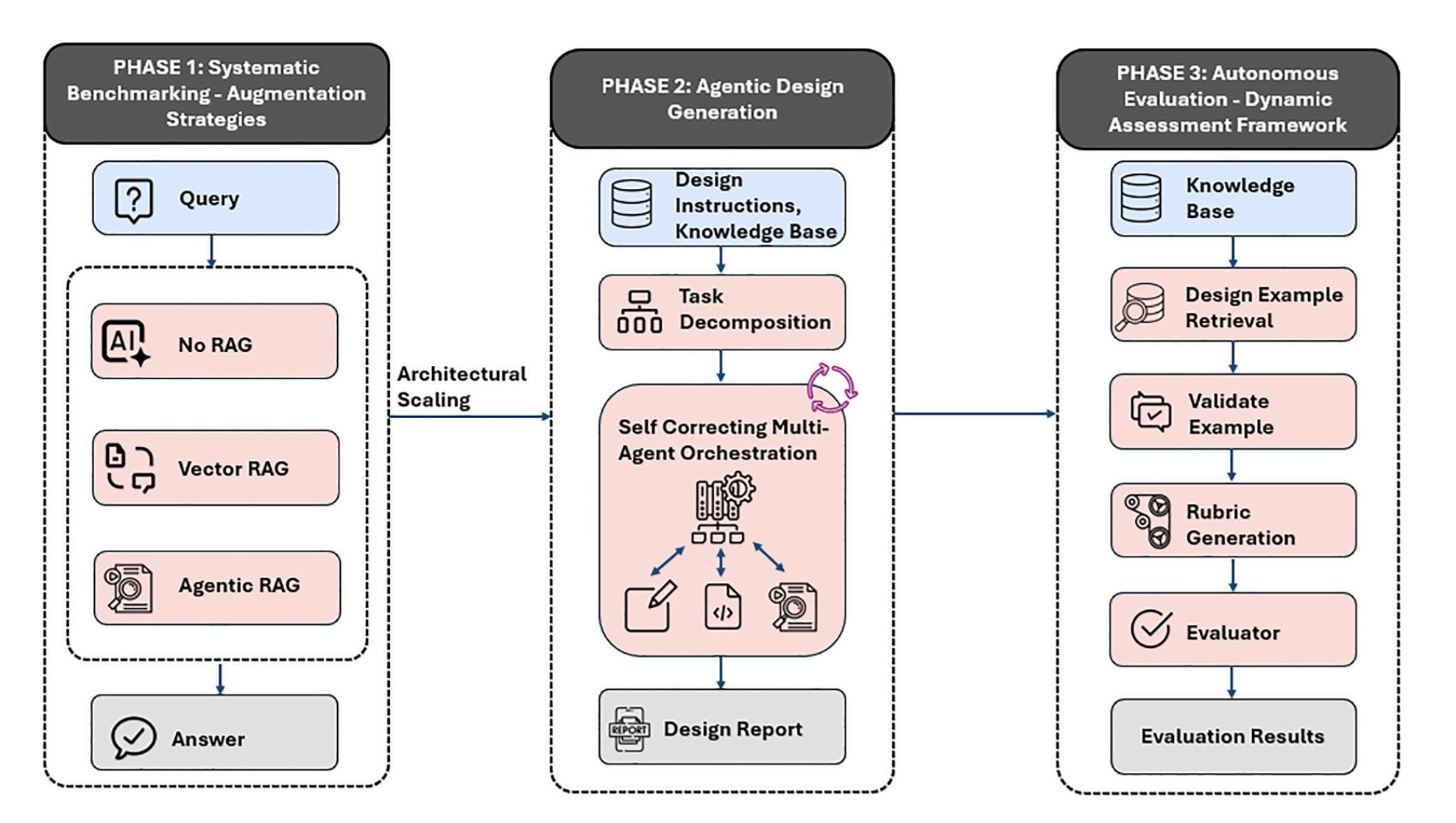
Large language models are increasingly being piloted in civil engineering firms to automate workflows and help engineers navigate dense design codes and specifications. However, safety critical use remains limited by reliability concerns, inconsistent reasoning, and the need for auditable, code grounded outputs suitable for quality control. While retrieval augmentation and agentic workflows have improved factuality in other domains, their effectiveness in civil engineering has not been systematically established, and it remains unclear how to scale them into transparent, code compliant design pipelines with reliable evaluation. To address these limitations, we develop the first benchmark, PE Civil Bench, consisting of Fundamentals of Engineering and Professional Engineering Civil examination questions and produce baseline scores of thirteen frontier and open weight large language models, including the state-of-the-art GPT-5.5, under baseline prompting, conventional retrieval-augmented generation (RAG), and agentic RAG. We then develop a retrieval-augmented multi-agent framework for fully automated concrete element design, demonstrated on reinforced concrete beams and columns, that infers design steps from worked examples and performs code retrieval, calculation, validation, and iterative self-correction with transparent traces. Across 33 beam configurations it produced code-compliant designs in all cases and closely matched ETABS finite-element outputs (r ≥ 0.90). Requiring only a new reference example and no reprogramming, the same architecture extended to column design. Finally, we introduce an autonomous RAG-based evaluator that extracts assessment criteria from reference solutions and agrees strongly with a traditional rule-based scorer (r = 0.976).